Nine chapters, one grid. The Rostify mark is the map of this page.
Staffed. Licensed. Briefed.
A good plan.
Rostify runs the roster of an ATC unit — and everything it depends on: position plan, shift patterns, daily OPS schedule, licences, e-briefings and on-the-job training.
Almost eight years in daily operation at European ANSPs.
- Safe operations
- Audit-ready records
- 0% lost OJT time
- Satisfied staff
- Fair rosters
- Smooth shifts
- Faster planning
- Organisational gains
- Financial savings
One chain. From demand to the controller on position.
Generic rostering starts with people. Rostify starts with positions — and carries that demand through every step. Change the position plan and the shifts, the roster and the OPS schedule follow. No spreadsheet in between.
- Chapter 03 Position plan Which positions must be open — per 15, 30 or 60 minutes, per season.
- Chapter 03 Optimal pattern The shifts that cover it — calculated against your rules.
- Chapter 02 Roster Monthly rosters, checked for rest, fatigue and requests.
- Chapter 04 OPS schedule Who works which position, slot by slot.
- Chapter 07 Crew app Every controller’s current roster, swaps and leave.
Rosters that check themselves.
Generate a month in one click along editable patterns. Every assignment is checked against rest periods, fatigue limits, general and single shift requests, licence validity and many more parameters — conflicts are visible before publication, not on the day. Across all watches — job sharers included.
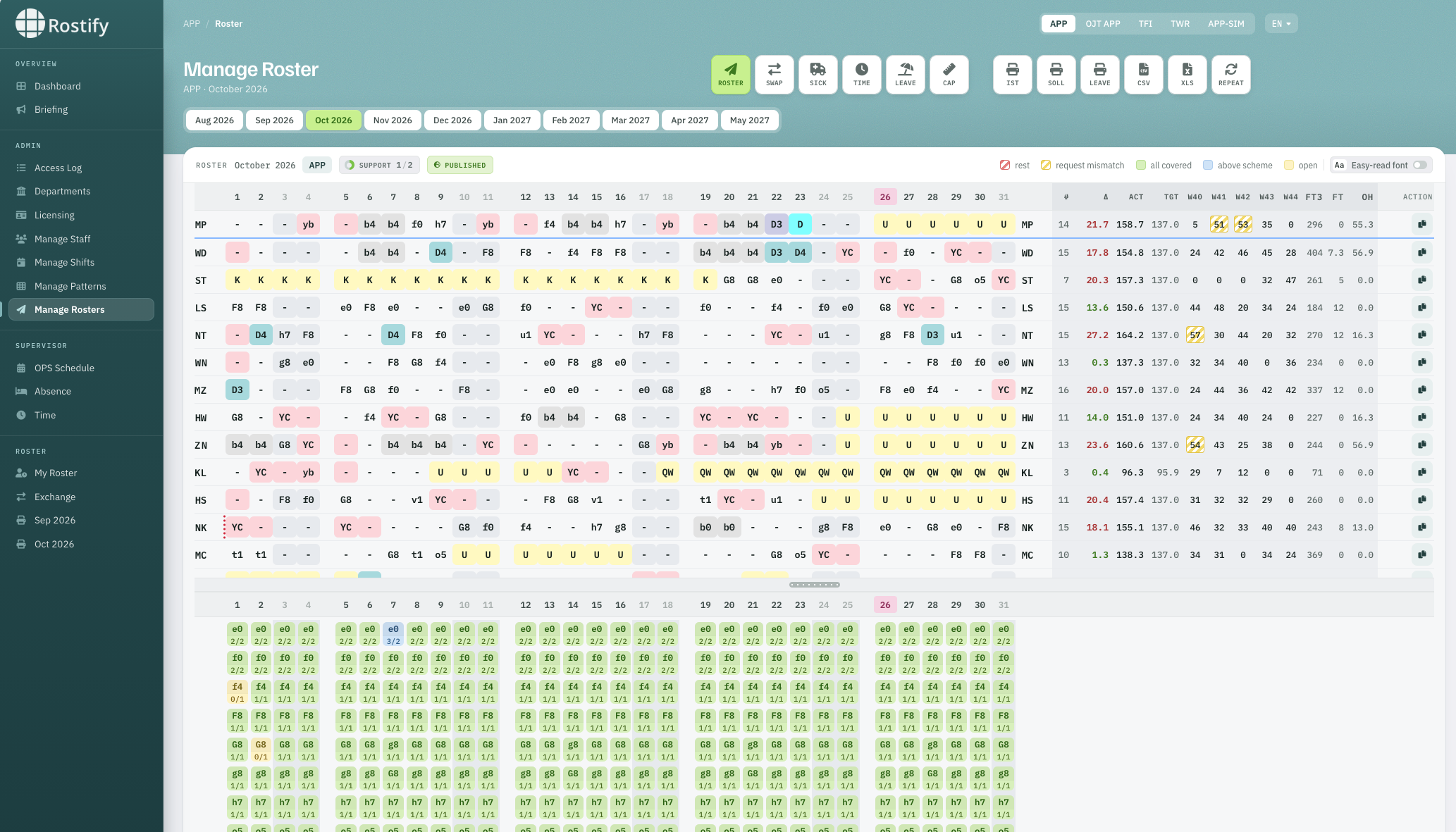
- 1Units APP, OJT APP, TFI, TWR, APP-SIM — one system.
- 2Roster, swap, sick, time, leave — one click from the grid.
- 3Cell states: rest, request mismatch, covered, above scheme, open.
- 4Actual against target hours, per week and month.
- 5Coverage per shift code and day.
Your rostering limits, as rules.
ATS providers have to specify these elements of their rostering system. Rostify checks each assignment against them — at generation, on every swap and on every replacement.
- a1Max. consecutive working days
- a2Max. hours per duty period
- a3Max. time on position without break
- a4Ratio of duty periods to breaks
- a5Min. rest periods
- a6Max. consecutive night duties
- a7Min. rest after night duty
- a8Min. rest periods per roster cycle
- …and many more. In automatic planning Rostify weighs 75 parameters — or you plan fully by hand.
Plan the positions. Protect the people.
Model every position your unit has to staff — supervisor, executive and planner positions, standby, briefing and breaks — in a 15-, 30- or 60-minute grid, valid for a season or traffic period. Then shape shifts people can live with — rest, fatigue and fairness are part of the calculation, not an afterthought.
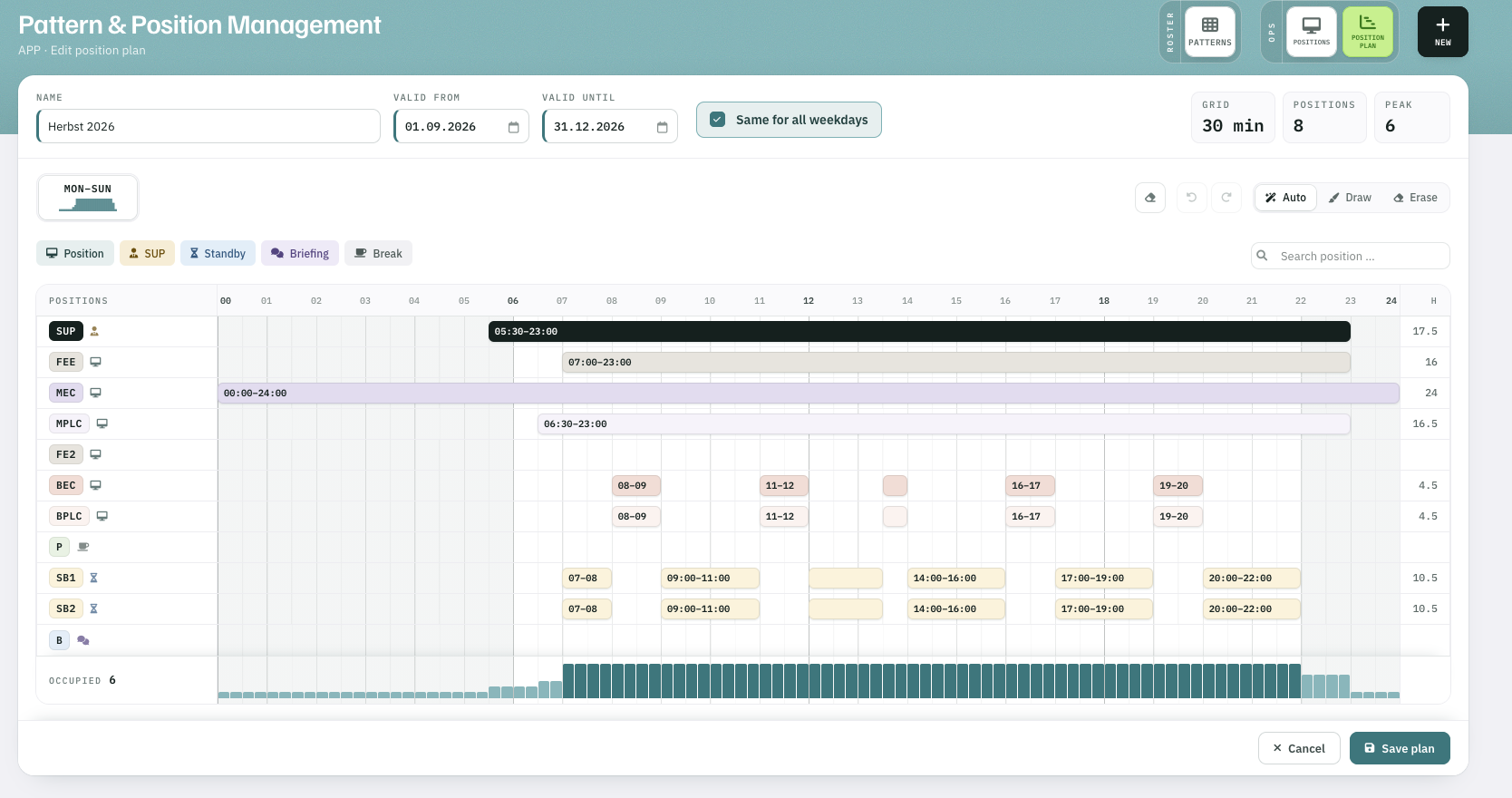
- 1Validity per season or traffic period.
- 2Position types: position, SUP, standby, briefing, break.
- 3Draw blocks by hand or place them automatically.
- 415-, 30- or 60-minute grid — here 30 min, SUP 05:30–23:00.
- 5Occupancy profile of the day — peak 6 positions.
The engine calculates the shifts that cover it.
Economical or employee-friendly, normal or long shifts, briefing at the start or the end of duty. Rostify returns the required shifts per weekday, checks them against your rule set and marks the shift types you don’t have yet.
- 1,160.6 h
- per week — optimal pattern
- −95.2 h
- per week vs. existing shifts (−7.6 %)
- 0
- uncovered positions
- 0
- rule violations
Example unit · pattern for December 2026 · economical, long shifts preferred, briefing at the end.
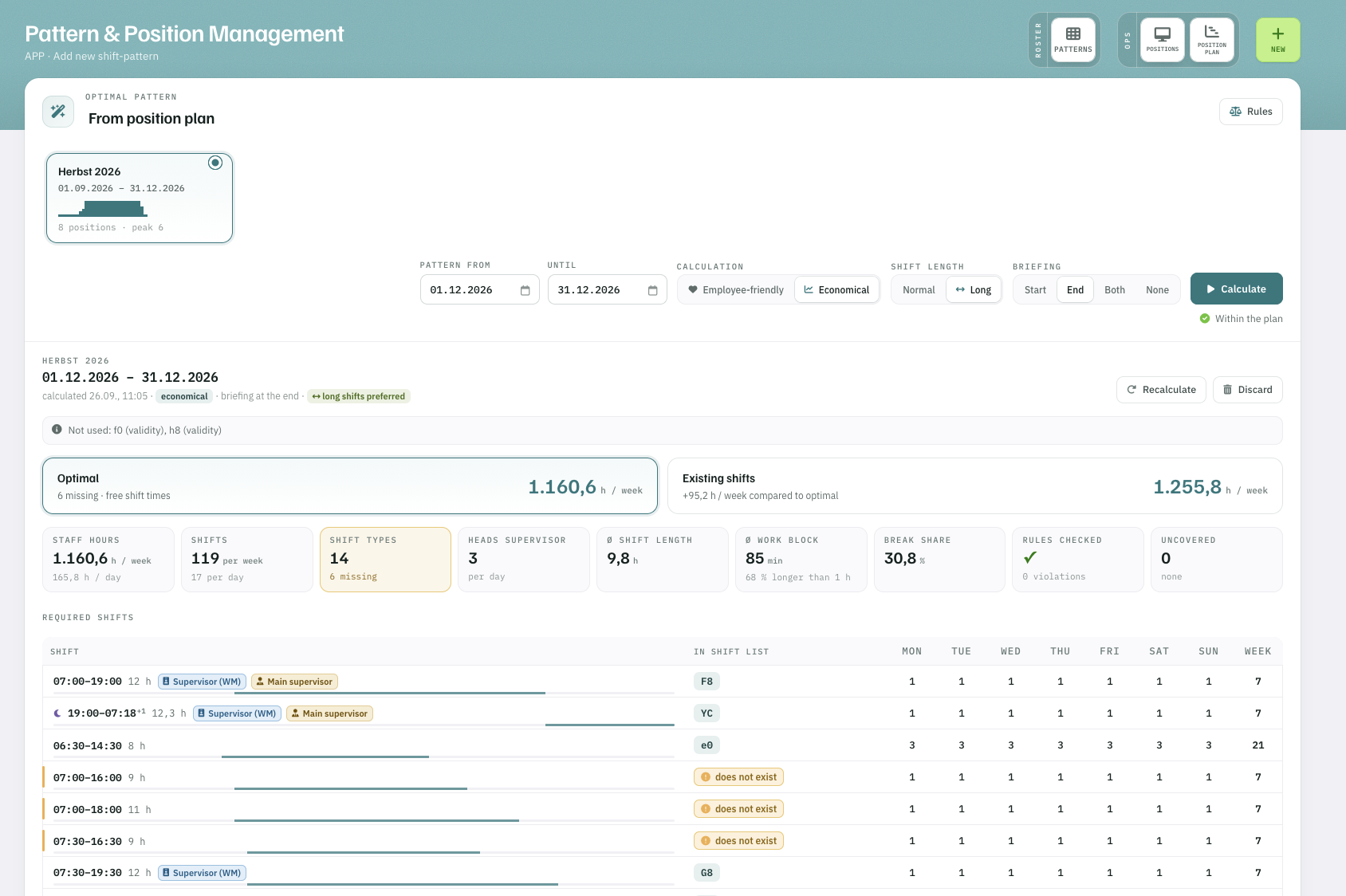
- 1Calculation: employee-friendly or economical.
- 2Optimal against existing shifts, hours per week.
- 3Every result checked against the rule set.
- 4Shift types that don’t exist yet — create them in one step.
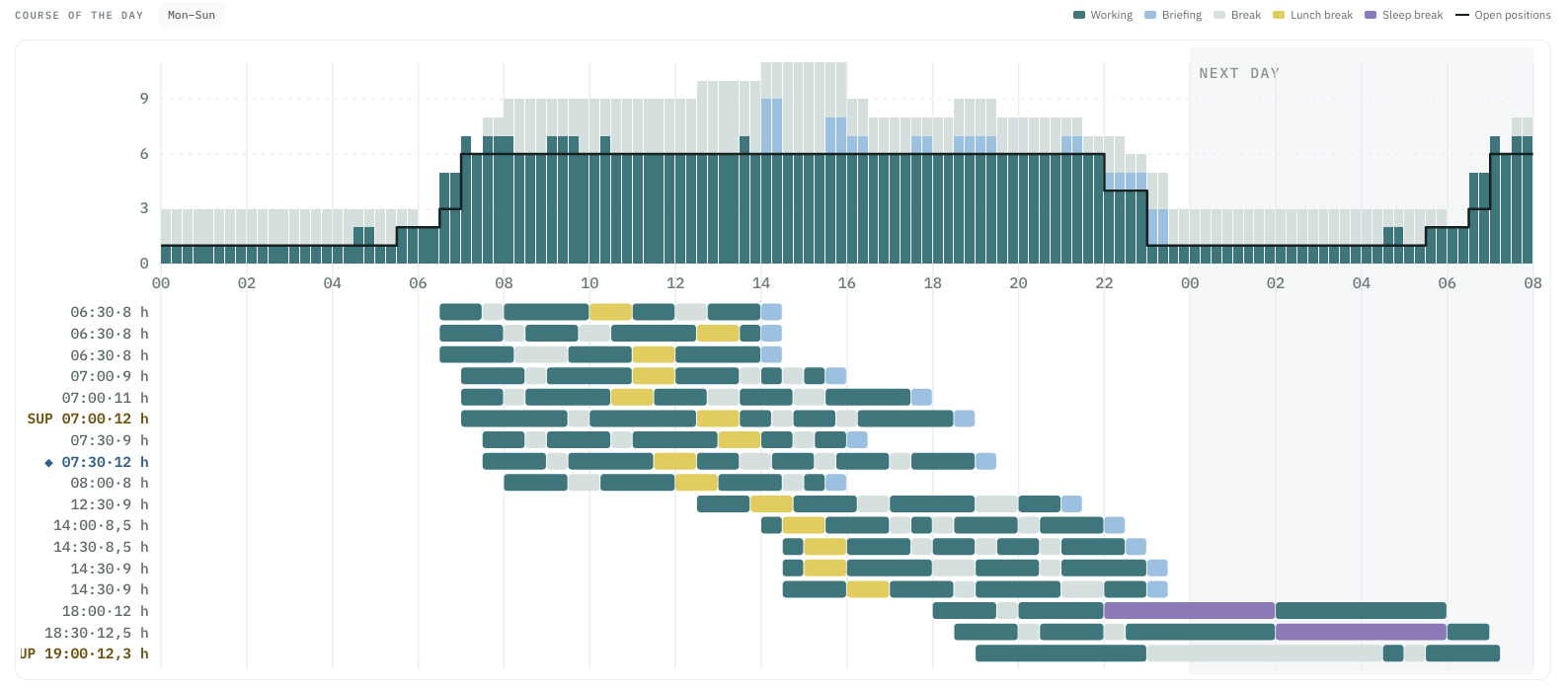
- 1Required positions (line) against staff on duty (bars).
- 2Briefing time where you want it — here at the end of duty.
- 3Night duty with planned sleep break.
- 4Night shifts run on into the next day.
Position by position. Slot by slot.
The OPS schedule turns the roster into the day. Supervisors assign positions to the controllers on duty — by hand or automatically — with the NOW line, last night’s handover, unstaffed requirements and double assignments in plain sight. In local time and UTC.
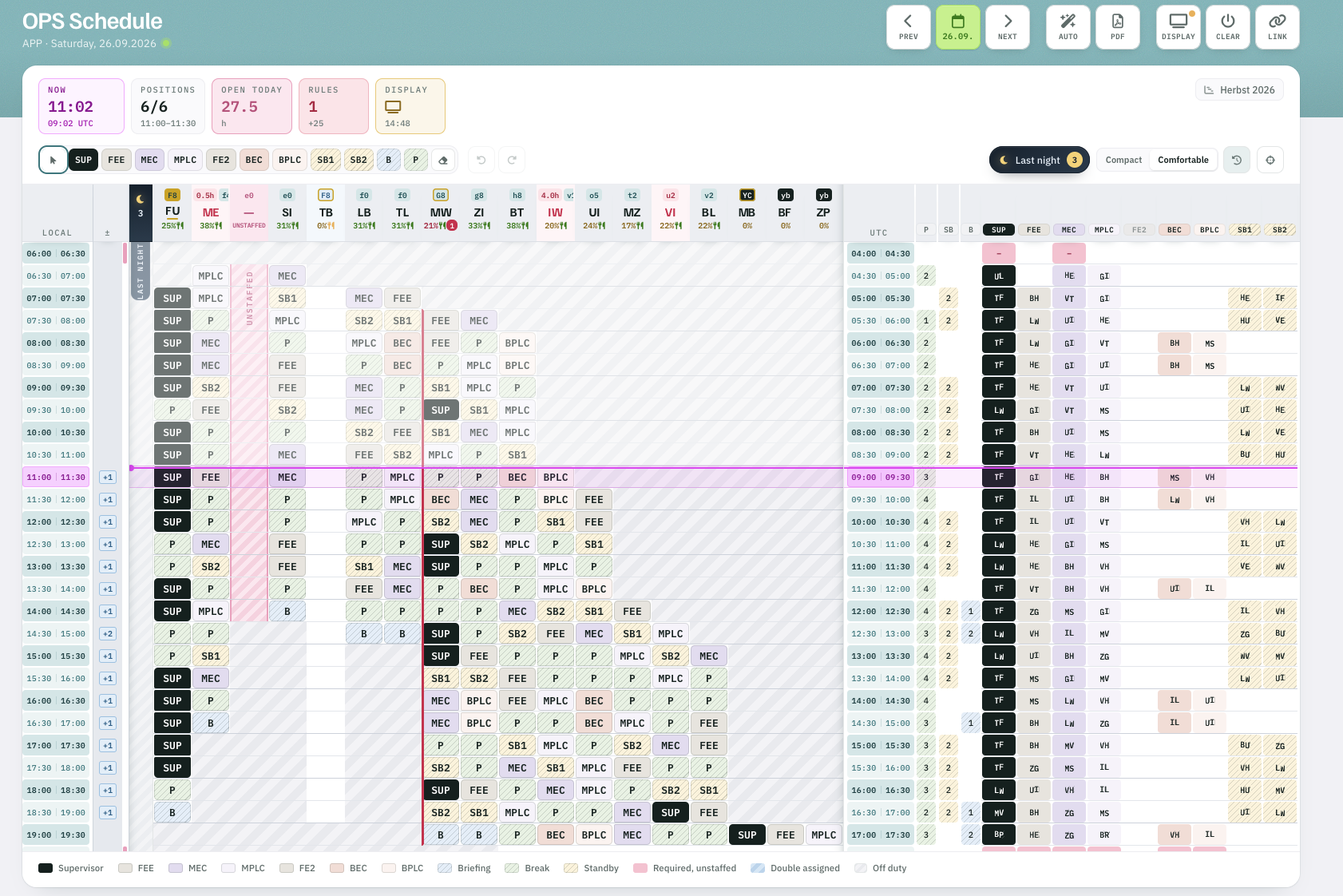
- 1NOW in local time and UTC.
- 2Positions staffed, open hours today, rule hits.
- 3Last night — handover from the night duty.
- 4Required but unstaffed — impossible to overlook.
- 5NOW line across every position.
- 6UTC view: who is on which position.
- 7Display mode and share link for the ops room.
Every trainee has their trainer.
Trainee and OJTI are rostered as a pair and put on the same position in the OPS schedule. No training slot without a trainer, no gaps in the training plan — and the training time is documented per trainee.
Expiry is never a surprise.
Licences, ratings, endorsements and hour requirements live in one tree per controller. Each shift declares which of them it requires. If an assignment doesn’t match, Rostify warns the administrator and the supervisor — the plan itself keeps running. Alerts go out before anything expires.
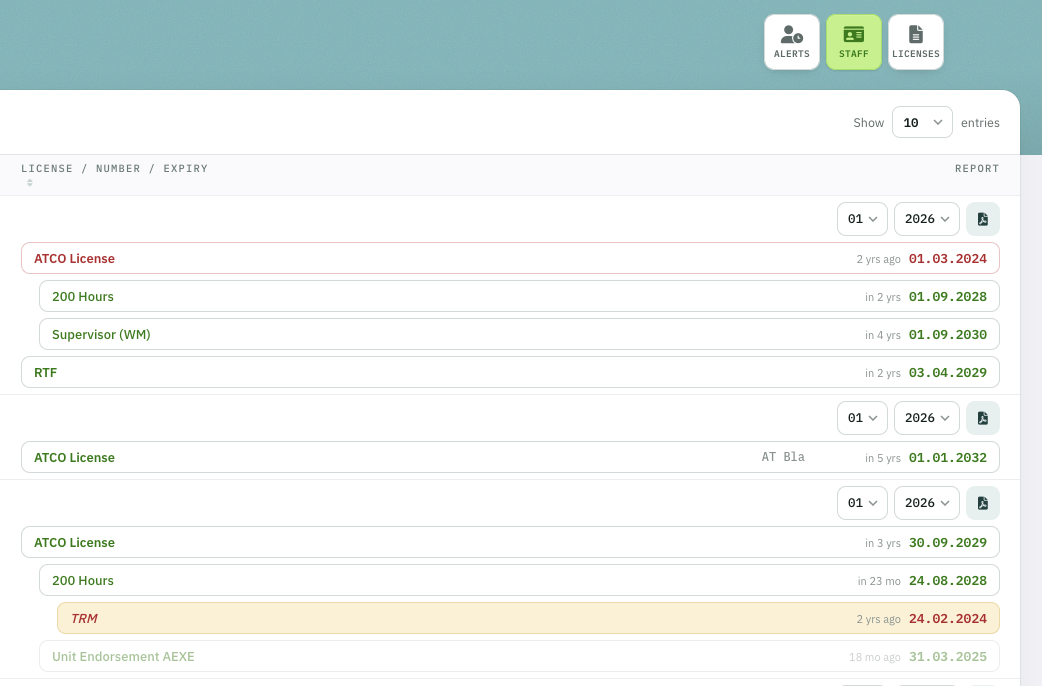
- 1Expired — flagged in red.
- 2Dependent licences nest under their parent.
- 3Time to expiry at a glance.
- 4Warning threshold hit — highlighted.
- 5Licence report per controller and month, as PDF.
- 6Alerts for admins and controllers.
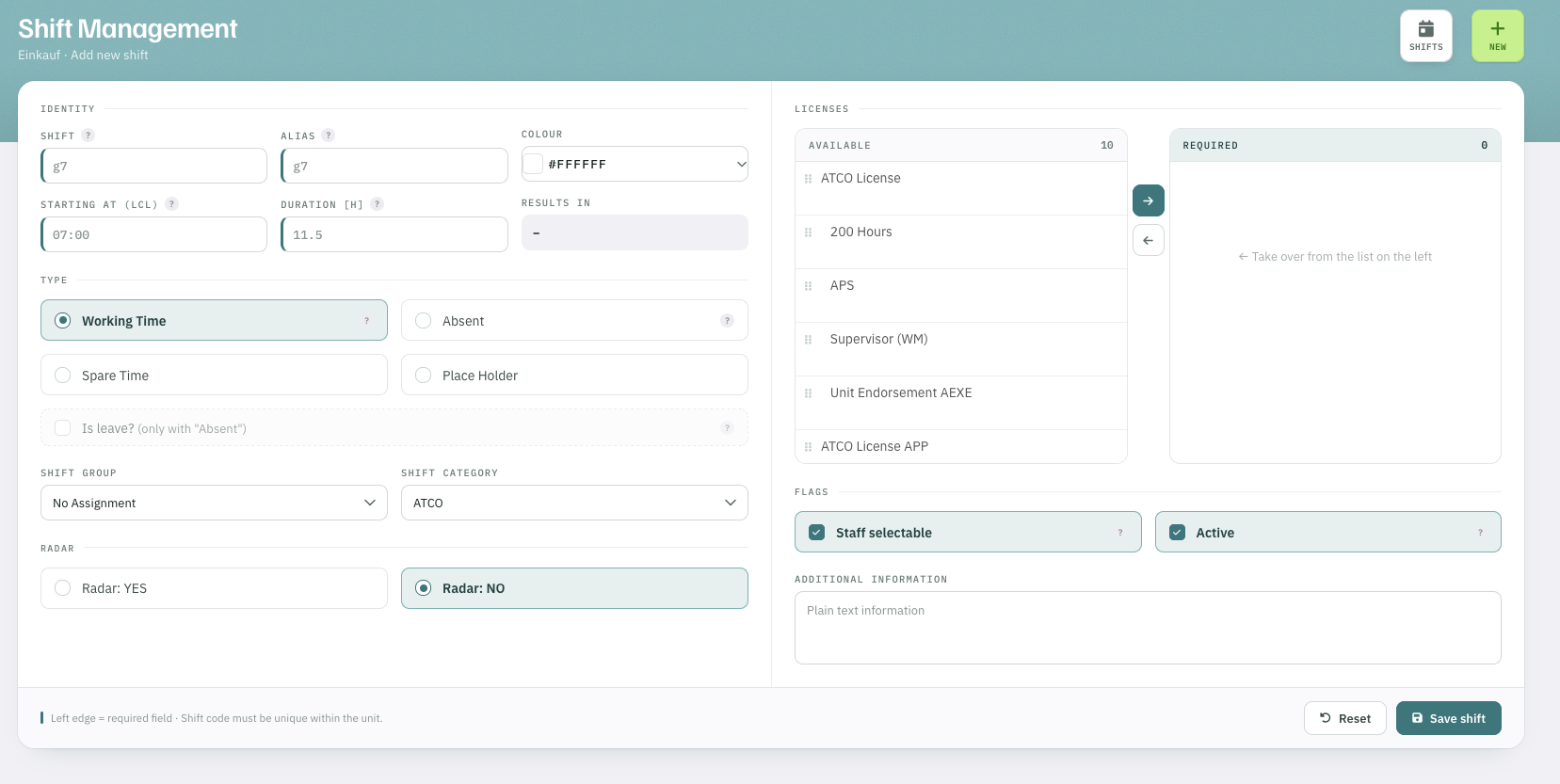
- 1Move licences from available to required.
- 2Required licences for this shift.
- 3Start in local time, duration in hours.
- 4Radar or non-radar shift.
- 5Selectable by staff for requests; active or archived.
Every briefing read — provably.
Mandatory or informative, addressed to departments, groups or single controllers, with up to five attachments — plus daily briefings, e.g. from the supervisor. Every read is confirmed per person; whoever is unbriefed shows up on the supervisor dashboard before taking position.
The roster in every controller’s pocket.
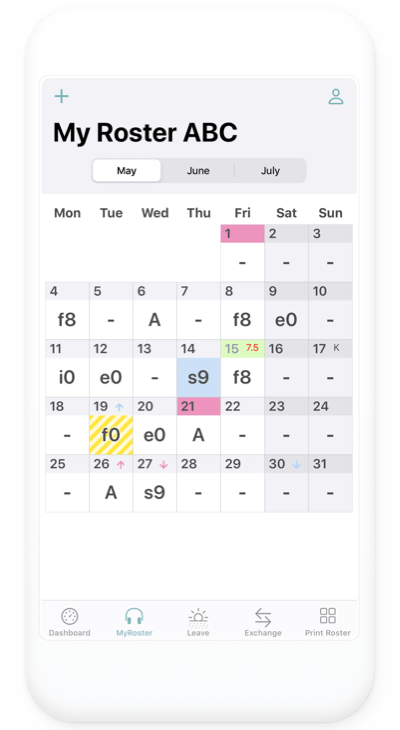
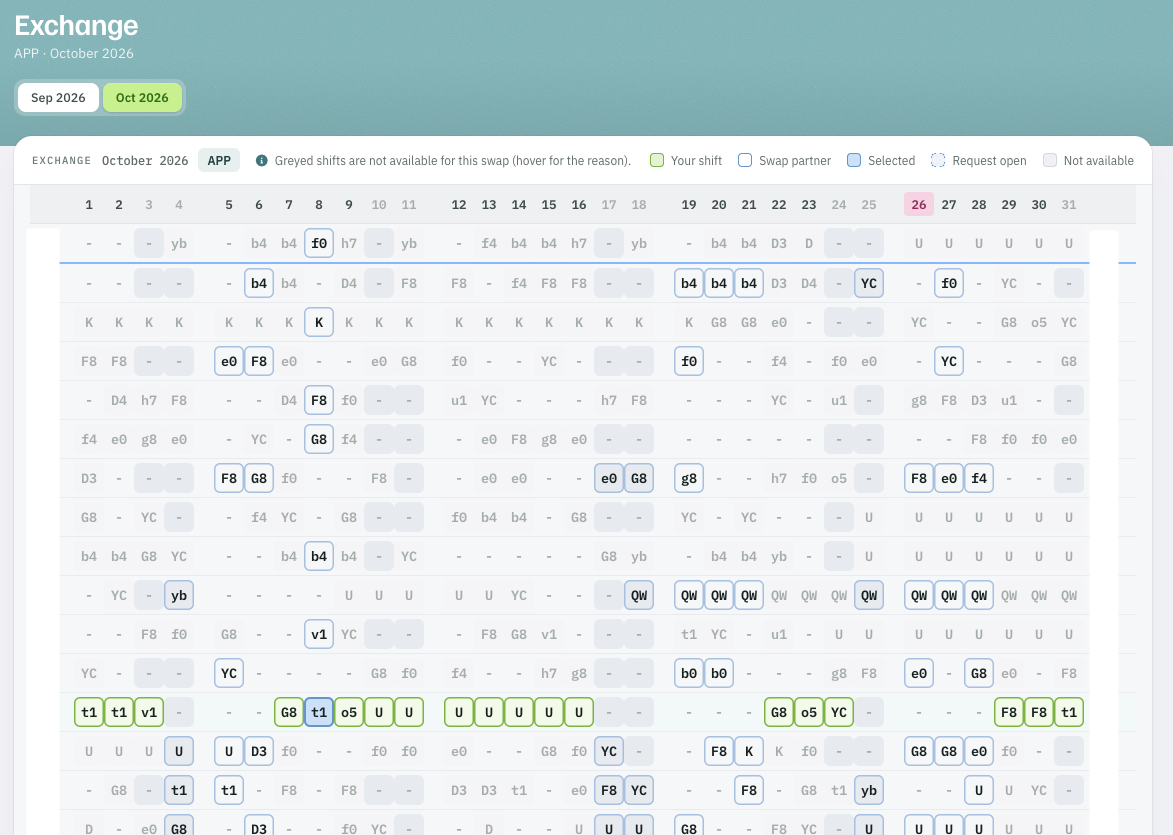
My Roster in the app and the browser: current roster, hours, swap requests with rule check, leave requests and briefings. The same database as the ops room — no printed roster on the wall, no stale PDF.
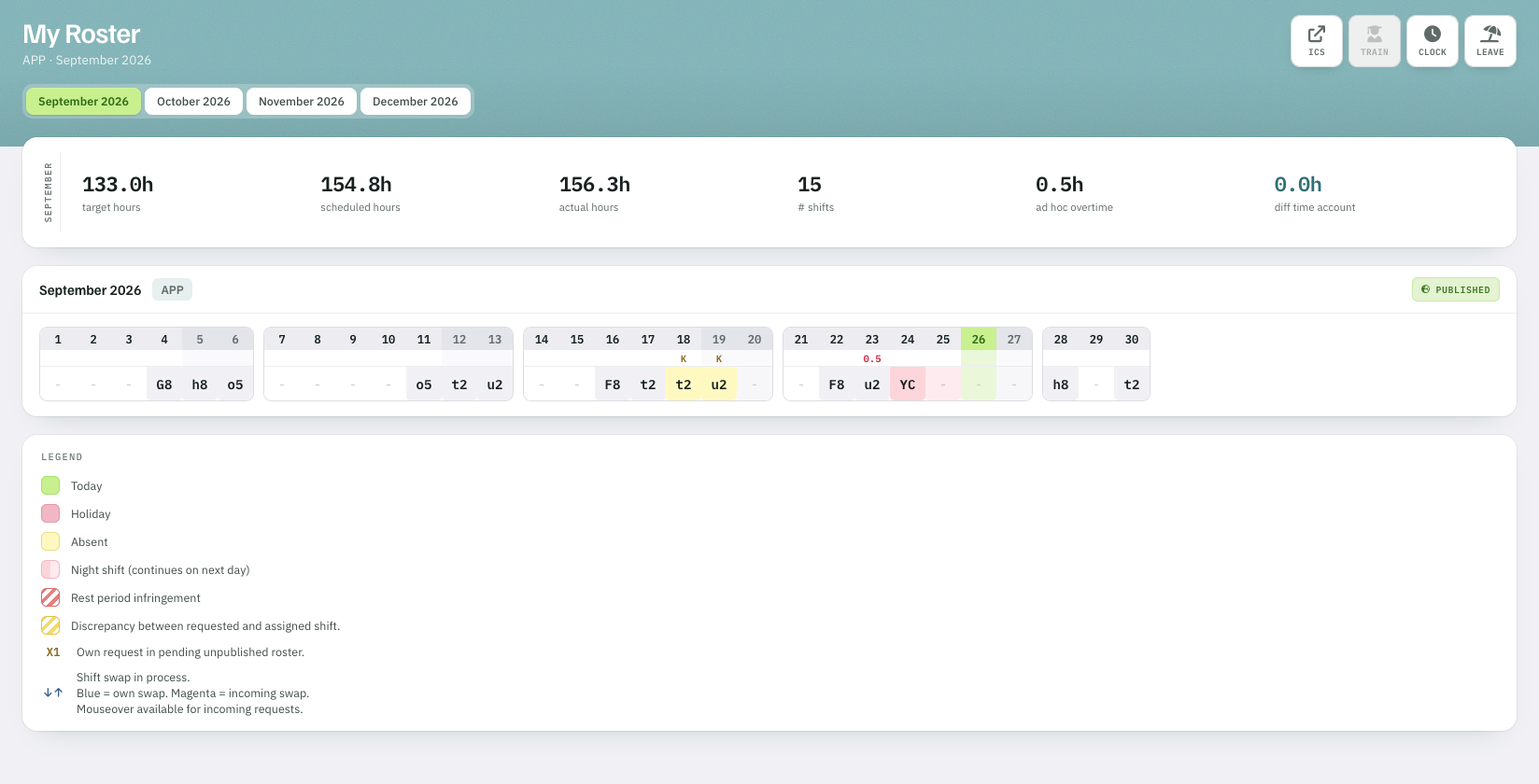
- Shift Trading
- Only rule-compliant partners are offered. Greyed shifts show why they can’t be swapped.
- Leave
- Requests go straight into leave planning and the annual view.
- Requests
- Shift wishes feed the next generation — mismatches are marked, not hidden.
- Calendar
- ICS export into the controller’s own calendar.
Same problem. Other control rooms.
Wherever qualified people hold positions around the clock and must prove they were briefed, the model is identical. Only the names change.
Technical data.
- Deployment
- Cloud, in the browser — no installation
- Development, hosting
- Vienna, Austria and Germany (EU)
- Organisation
- Units and departments — e.g. ACC, APP, TWR, OJT, SIM — with their own settings
- Scale
- 2 to 2,000 staff
- Time base
- Local time and UTC
- Rostering
- 1-click generation along editable patterns, or fully manual · across watches, incl. job sharers
- Position planning
- 15-, 30- or 60-minute grid, validity per season or traffic period
- Pattern engine
- Economical or employee-friendly · normal or long shifts · briefing at start or end · or fully manual design
- Rule checks
- Rest, fatigue and duty limits, shift and general requests · automatic planning (optional) weighs 75 parameters
- Licensing
- Licence tree per person, warning thresholds, PDF report · issues warn admin and supervisor, never block the plan
- Training (OJT)
- Trainer–trainee pairing, OJT unit roster, training documentation
- E-Briefing
- Mandatory or informative, daily briefings (e.g. from the supervisor), up to 5 attachments, read confirmation per user
- Absence
- Sick leave, replacement proposals, overtime requests by SMS, overtime volunteering via the app
- Ops room
- Display mode and share link for the OPS schedule
- Exports
- PDF, CSV, XLS, ICS · actual, target and leave prints
- Audit
- Access log
- Languages
- English, German · easy-read font option
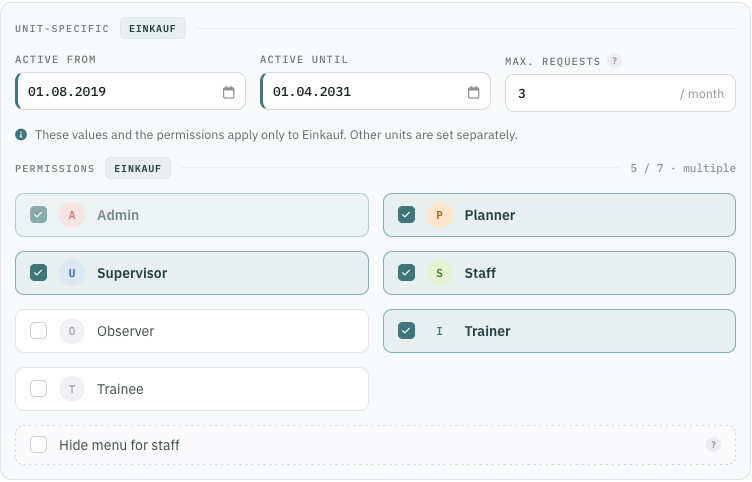
Seven roles — admin, planner, supervisor, staff, observer, trainer, trainee — combined per person and set per unit. An instructor can be trainer in APP and staff in TWR.
Bring one month of your roster.
Show us your shift logic and we’ll rebuild it in Rostify shortly — with your shift codes, your roster, your licences, your requirements. No complex installation. You get limited demo access and see for yourself.